
AI Video Camera Movements, Angles & Shot Sizes: Complete Prompt Engineering Guide
Master spatial camera vocabulary for AI video models. Learn how to prompt pans, tilts, dollies, tracking moves, Dutch angles, and vertigo zooms without subject distortion or perspective tearing.
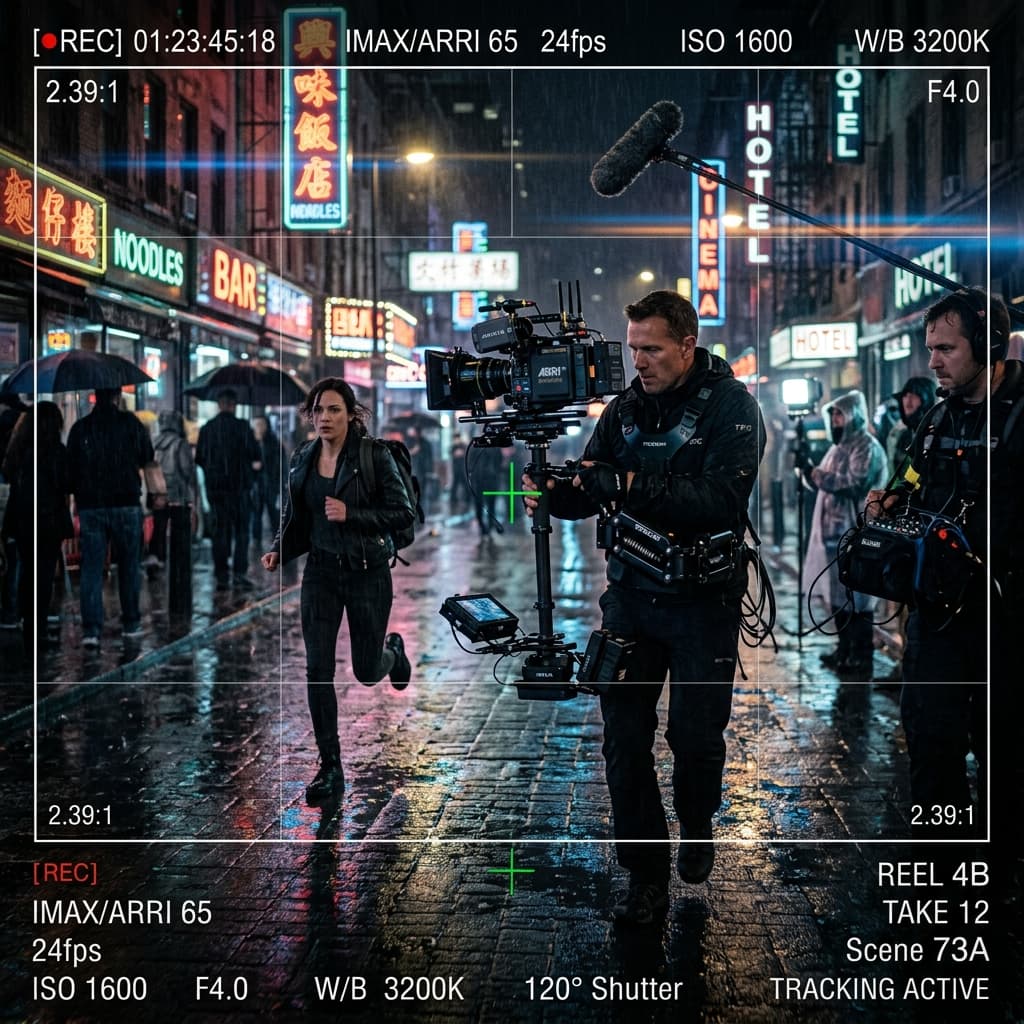
The Golden Rule of AI Camera Prompting
AI video models do not possess physical camera lenses or motors. They generate pixels over time based on statistical associations. When you say "The camera swoops dynamically", the model blurs the background and morphs the subject. To get rock-solid motion, you must declare: 1) Camera starting position, 2) Movement axis & speed, and 3) What remains completely stationary.
1. Shot Sizes: Framing the Scene
Shot size establishes scale and emotional distance. If you fail to specify shot size, the model default is almost always a bland chest-up medium shot. Use the standard film scale below:
| Shot Size | Frame Shows | Best Used For | Prompt Trigger |
|---|---|---|---|
| Extreme Wide Shot (EWS) | Massive landscape, character is a tiny speck | World building, solitude, scale | Extreme wide landscape shot, tiny figure |
| Wide Shot (WS) | Full body with abundant environmental context | Spatial relationships, entrances | Wide shot, full figure with room above head |
| Full Shot (FS) | Character head to toe, ground to top of frame | Wardrobe, walking mechanics, body posture | Full shot from head to boots |
| Medium Shot (MS) | Waist up to head | Dialogue, casual conversation | Medium shot, framed from waist up |
| Close-Up (CU) | Head and shoulders only | Subtle acting, micro-expressions | Close-up shot of face and collarbone |
| Extreme Close-Up (ECU) | Only eyes, lips, or a single prop mechanism | High tension, panic, fine detail reveal | Extreme macro close-up of iris and pupil |
2. Camera Angles: Emotional Perspective
The angle of the lens immediately dictates who holds psychological power in the shot.
Eye-Level Shot
Positions the lens at the subject's exact eye plane. Establishes parity and documentary authenticity.
Low-Angle Shot
Camera looks upward from knee or waist height. The subject towers over the frame, projecting power or intimidation.
High-Angle & Bird's-Eye
Camera looks down at the character. Makes the character appear small, trapped, or observed by an omniscient presence.
Dutch Angle (Canted)
The horizon line is deliberately tilted 15 to 25 degrees. Signals psychological distress or paranormal unbalance.
3. Camera Movements: Kinetic Direction
The handbook defines 22 precise movement mechanics. Here are the 8 foundational moves with exact prompt syntax:
The tripod head stays stationary while the lens sweeps left-to-right (Pan) or up-and-down (Tilt).
Dolly: The physical camera moves physically forward on tracks, causing background parallax. Zoom: Focal length changes without perspective change.
Smooth mechanical stabilization following a moving subject through dynamic environments.
Camera orbits in a circular curve around a central character, rotating the background scenery around them.
4. Avoiding the Deadly Mistakes: Avoid vs. Correct
"The camera moves really fast and dramatically swoops around the room showing everything in crazy cinematic 8k detail."
"CAMERA: Medium shot. Slow, linear dolly push-in of 1 meter toward the desk over 4 seconds. Horizon remains locked level. No panning or tilting."
5. Camera Speed Calibration Vocabulary
AI models interpret adjectives differently. Here is the exact scale tested across Botock, Kling 1.5, and Sora:
Suspense, psychological tension
Dialogue scenes, establishing shots
Tracking a walking character
High-speed transition between subjects