
1What Tesla Just Showed the World
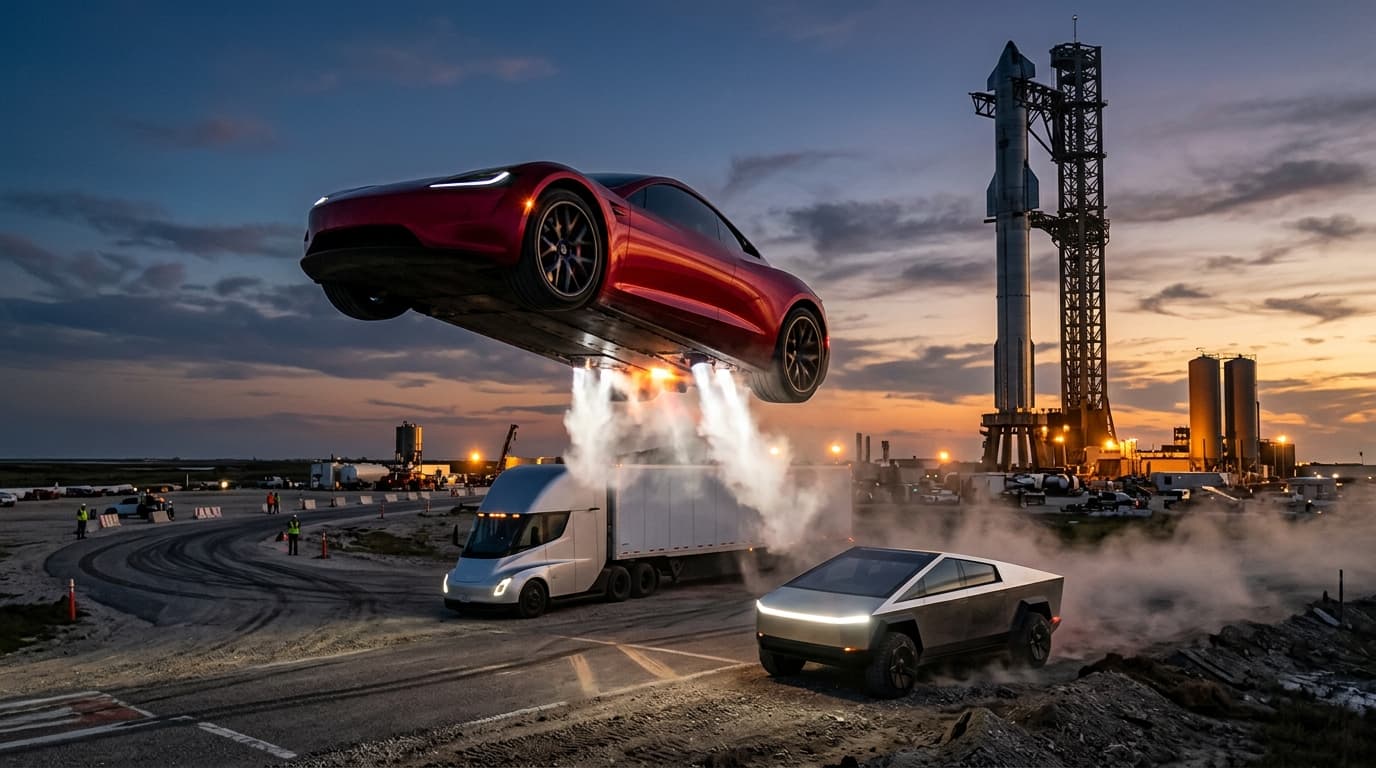
Tesla just built a car that drives upside down, jumps over a massive Semi truck, and flips in mid-air—and none of it was Hollywood CGI or camera sleight-of-hand.
On the night of October 15, 2026, at a heavily secured SpaceX rocket testing facility inMcGregor, Texas, Elon Musk finally took the wraps off the long-delayed second-generation Tesla Roadster. The reveal came exactly nine years after the machine was first previewed as a “one more thing” surprise at the 2017 Semi reveal.
The Live Demo: Upside Down, Then Airborne
During the livestreamed demonstration, the low-slung red prototype accelerated up an engineered curved ramp loop. As it hit the inverted apex, active underbody suction fans sealed the vehicle against the overhead track, defying gravity at zero wheel slip. Moments later, high-pressure cold-gas thrusters discharged, launching the vehicle off a launch lip into free flight. The car performed a controlled 180-degree mid-air roll, stabilized via micro-actuators, and touched down squarely on all four wheels. In an encore stunt, it jumped cleanly across a bumper-to-bumper lineup consisting of a Cybercab, Cybertruck, Tesla Semi, Model Y, and Model 3.
2The Technology Behind It: Four Engineering Pillars
Achieving vehicle maneuvers usually reserved for video games required merging SpaceX aerospace propulsion with automotive mechatronics. Four distinct technologies make this possible:
1. Cold-Gas Thruster Array
Ten aerospace-grade thrusters are plumbed into a massive 600-liter compressed air reservoir. Developed in direct partnership with SpaceX rocket engineers, the nozzles can be refilled via an on-board multistage compressor, providing both directional lift and rotational torque.
2. Active Suction Ground-Effect Fans
Borrowing heritage from the Gordon Murray T.50 and McMurtry Spéirling, high-power electric turbine fans generate up to 2Gs of vacuum suction. This downforce sticks the chassis to inverted loops and eliminates mechanical cornering limitations on high-speed circuits.
3. Steer-by-Wire & SpaceX COPVs
To offset the weight of pressure vessels, the cabin eliminates heavy mechanical steering shafts in favor of pure steer-by-wire with a yoke controller. High-pressure tanks useCarbon-Overwrapped Pressure Vessels (COPVs), identical to those holding helium in Falcon 9 upper stages.
4. Ultra-Fast Electric Actuators
Releasing pressurized gas without pitch-yaw stability would result in immediate catastrophic tumbling. High-frequency electric solenoids modulate nozzle valves hundreds of times per second, dynamically trimming the vehicle's attitude in mid-air like a spacecraft docking thruster.
3How It Actually Works: Physics Without The Magic
Stripped of marketing hyperbole, the Roadster operates on classical Newtonian mechanics: specifically Newton's Third Law of Motion (“for every action, there is an equal and opposite reaction”).
When the car requires flight impulse, solenoids crack open the COPV manifolds. Stored air—pressurized to thousands of pounds per square inch—expands through convergent-divergent de Laval nozzles at supersonic exit velocities. Because there is no combustion, there is no thermal signature, flame, or fuel exhaust: just an immense pressure differential pushing the vehicle upward or laterally.
While airborne, an on-board 6-axis Inertial Measurement Unit (IMU) samples pitch, roll, and yaw drift. If the tail begins rotating 2 degrees off-axis, counter-valves fire micro-pulses in 12-millisecond bursts, snapping the vehicle parallel to the landing strip before the suspension dampers take the impact.
4The Three Versions: From Tri-Motor to Rocket Trim
Tesla outlined a three-tier hierarchy for the second-generation Roadster lineup, dividing conventional track performance from experimental rocket thruster packages:
| Trim Name | Seating | Propulsion Tech | 0–60 MPH | Target Use |
|---|---|---|---|---|
| Performance | 2+2 Seater | Tri-Motor All-Wheel Drive, Plaid Battery | ~1.9 seconds | Street legal hypercar & long-distance GT |
| Thrust (“Race Ready”) | 2 Seater | Tri-Motor + Twin Rear Cold-Gas Boosters | < 1.0 second | Drag strip domination & track records |
| Rocket (“Air Ready”) | 1 Seater (Central) | 10 Cold-Gas Thrusters + 2G Suction Fans + COPVs | 0.81s (Demo) / <0.59s (Claim) | Airborne jumps, flips, inverted ceiling driving |
Note: The single-seat configuration on the Rocket version is mandatory because high-pressure carbon tanks occupy the rear passenger space and passenger front quadrant.
5Is It a Success? Honest Reality vs. Spectacle
The internet erupted immediately after the McGregor livestream. But separating engineering reality from viral marketing requires an unvarnished look at both sides of the coin.
- The Hardware Worked: The prototype executed inverted driving, jumped a 70-foot fleet, and landed intact on live cameras.
- Ground-Effect Downforce Proven: The 2G suction system replicates Formula 1-level downforce at zero vehicle speed.
- Cross-Disciplinary Engineering: SpaceX COPV integration represents genuine bleeding-edge aerospace material transfer.
- Severe Regulatory Hurdle: As reported by Electrek, high-pressure gas venting and open fan systems face steep DOT/NHTSA crash safety and pedestrian hazards.
- Price Uncertainty ($1M+?): Base deposits are $50,000–$250,000, but aerospace certs could push the Rocket package well into seven figures.
- Chronic Timeline Slips: Originally promised for 2020, production is now tentatively pushed to 2028.
- Musk's Own Caveat: Prior to the demo, Elon himself admitted on social media that “success was not guaranteed.”
6Can This Ever Become a Flying Car? (The Cold Hard Truth)
The short, unambiguous answer: it can hop, but it cannot truly fly.
Understanding why requires looking past Tesla's PR and examining basic energy density and aeronautics:
1. The Compressed Air Depletion Limit
A 600-liter air tank under extreme pressure expends its peak propulsive impulse in roughly 4 to 8 seconds. Once exhausted, the car is an unpowered 4,000-pound projectile subject to gravity. Sustained hover is physically impossible without enormous continuous energy.
2. Thermodynamic Inefficiency of Cold Gas
Cold-gas thrusters have a specific impulse (I_sp) of only 60 to 75 seconds. Chemical rockets achieve 300–450 seconds. Using cold gas to lift an automobile requires an enormous mass of tanks for very little total mechanical work.
3. Real Flying Cars Rely on Aerodynamic eVTOLs
Legitimate urban air mobility is being pioneered by companies like Joby Aviation, Archer Aviation, and XPeng AeroHT. These vehicles fly using distributed electric rotors and fixed wings that generate aerodynamic lift, consuming a fraction of the energy per kilometer compared to rocket thrust.
4. The Aviation Regulatory Wall (FAA Part 23 & Air Traffic)
Any vehicle that leaves the ground encounters the FAA. Commercial operation requires airworthiness certification, pilot licensing, fail-safe redundant fly-by-wire avionics, and low-altitude airspace management that no automotive manufacturer currently possesses.
The Analytical Verdict
The second-generation Roadster is a breathtaking ground vehicle capable of rocket-assisted ballistic jumps. It is a spectacular technology demonstrator that pushes mechatronics forward, but it is not a flying car. Treat it as the world's wildest hypercar acrobat, not a commuter aircraft.
Would You Pay $250,000 to Jump Over a Truck?
Tesla didn't build a commercial flying car today, but it built the most dramatic proof of how wild automotive engineering can get. If delivery happens in 2028, where do you stand?
Share your perspective in the creator forums or tag #BotockAi on social media!
Editorial Notes & Verification Disclaimers
- Reservation Deposits: Confirmed reservation tiers sit between $50,000 and $250,000 for Founders Series slots. Final retail MSRP for thruster packages has not been formalized by Tesla.
- Unconfirmed Claims: Reports circulating regarding a 300-mile highway range under continuous thruster priming and top speeds exceeding 230+ mph originate from a single unverified leak and should be treated with caution.
- Safety Clearances: No filings with NHTSA or state highway patrol agencies for consumer-operated high-pressure air thrusters on public roads have been approved as of publication.
Coverage Sources Cited
TechCrunch, CNBC, The Next Web, InsideEVs, Electrek, The EV Report, and Kingy.ai press briefings and technical teardowns of the October 15, 2026 SpaceX McGregor demonstration.
Visualize Your Own Futuristic Concept Vehicles
Want to render airborne cyber-vehicles, rocket thrusters, or cinematic car chases? Generate photo-realistic renders and dynamic video clips right inside your browser with Botock AI.